
...
...
...
...
...
...
...
...
...
...
...
...
...
...
...
...
...
...
...
...
...
Project NatureConnect
Educating, Counseling and Healing With Nature (ECHN)
Practical distance learning to increase person/planet well being.
|
Most
of us have long-known that we must increase personal, social and
environmental well-being. Here is a natural 54-sense working model and self-evident process that
enables us to meet this goal sustainably. "This
is the course that every
civilized person will be required to take if we are to reverse our
runaway disorders." - Raymond Sierra, Counselor 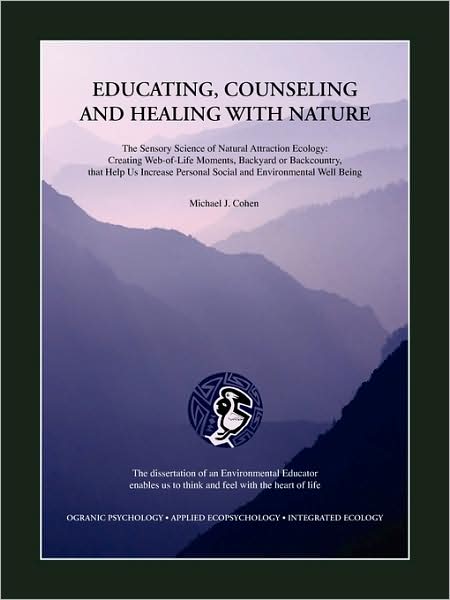 OVERVIEW: "For those of us who have validated our good experiences in nature, it is self-evident why modern humanity suffers its great personal, social, economic and environmental troubles. It is because we seldom learn to think like nature works, in and around us, to produce the beauty of its pure and balanced perfection. As Industrial Society's bias has conquered nature, it has prevented our psyche from benefiting from the self-correcting grace and restorative powers of nature. This profound disconnection leaves us wanting, and when we want there is never enough. Our wanting results in our greed, stress and lack of self-worth, in our excessiveness and disorders that rape the earth. There is hope. Even a walk in the park demonstrates that our troubles subside when we genuinely reconnect our psyche with nature. This explains why the healing science of Educating, Counseling and Healing With Nature helps us increase well being at every level. It enables our thinking to interlace with the genius of nature's peace and renewing ways, backyard or back country." The available-by-donation or Amazon Educating, Counseling and Healing With Nature book on these pages offers us the response from a Ph.D. to our excessive separation from the natural. It helps you explore the process of a funded, reviewed and applicable sensory-ecology science that is therapeutic. It gives us a working model that is organized around the discovery that 54 living-earth natural attractions register in our (Who Are We?) consciousness as natural senses. Their sensibilities make the book's Natural Attraction Ecology an organic, nature-connected psychology and therapy, an accredited learning and teaching tool that helps us increase personal, social and environmental well-being by dissolving Industrial Society's unreasonable prejudice against nature. It's "Natural System Thinking Process" enables our thoughts, feelings and spirit to genuinely tap into the renewing powers of nature's web of life community. This empowers us to own a rational passion that helps us benefit from and strengthen our inborn love of nature and life. Anyone may use and teach this monumental application of nature-connected ecopsychology to strengthen whole-life personal and professional relationships. A summary of it is available online. NOTE: The process of educating, counseling and healing with nature, described here, is implemented via the information and activities in another book The Web of Life Imperative Learn
how to remedy our great underlying disorder while you remedy its
symptoms.
PROGRAM DESCRIPTION: Educating
Counseling and
Healing With Nature
Supportive Degrees, Career Training Courses and Jobs On Line Project NatureConnect offers nature-centered distant learning that enables you to add the benefits of nature-connecting methods and credentials to your degree program and/or your skills, interests and hobbies. We honor your prior training and life experience by providing grants and equivalent education credit for it. You may take accredited or professional CEU coursework and/or obtain a Nature-Connected Degree or Certificate in most disciplines or personal interests. A partial subject list is located at the bottom of this page.
Visit our Homepage for
complete information
PLEASE NOTE: If you are interested in reviewing
this book (See
review, below) Contact Mike Cohen for
a review copy
of it,
888-285-4694 toll free in USA,
otherwise 360-378-6313.
nature@interisland.net A Press Release about this book is available at http://www.ecopsych.com/phdrelease.html Read a short overview of the book. You may read or download the book as a free E book in MS WORD http://www.ecopsych.com/ECHN.DOC You may read or download the book as a free E book in ACROBAT PDF http://www.maverickgenius.com/COUNSELING WITH NATURE.pdf You may edit and publish an article about the book and its program NOTE: The process of educating, counseling and healing with nature is implemented via the information and activities in the training book The Web of Life Imperative TABLE OF CONTENTS or SCROLL-DOWN SEQUENCE of this web page
An Announcement
you may publish or distribute A Review of the book that you may use or modify An Article about the book that you may publish or link to. An Invitation to Download the book, receive a review copy of it, publish an article or take a course based on it. Information About the Author The Forward, Title and Publisher's page The Preface of the book An Abstract of the book Chapter One: Introduction and Orientation Additional web pages: Chapter Two: Design and Method Chapter Three: Findings and Results NOTE: The process of educating, counseling and healing with nature is implemented via the information and activities in the training book The Web of Life Imperative ANNOUNCEMENT: Please announce this book's availability An invitation to review "Educating, Counseling and Healing With Nature" A new environmental science, outdoor learning psychology book "Educating, Counseling and Healing With Nature," by Michael J. Cohen, Ph.D, is available for review via http://www.ecopsych.com/ksanity.html or by requesting a review copy from the author at 360-378-6313, email <nature@interisland.net>. This 150 page, peer-reviewed paperback presents an accredited, sensory-ecology science whose activities reverse Industrial Society's unreasonable prejudice against nature. It demonstrates how Planet Earth's peace, balance and spirit registers in us through self -evident facts that are revealed by more than 53 natural senses and how the grace of nature's self-correcting and restorative powers help our thinking increase personal, social and environmental well-being. Return to page table of contents BOOK REVIEW AND DESCRIPTION Educating, Counseling and Healing With Nature by Michael J. Cohen Natural Attraction Ecology and The Web of Life Model: Planet Earth Speaks Through 53 Natural Senses For Personal, Social and Environmental Well-Being In his new sensory environmental science book, Educating, Counseling and Healing With Nature, Michael J. Cohen, Ph.D, demonstrates through a web-of-life ecology model that we inherit at least 53 natural senses and that the self-evident facts they disclose guide us to live in peaceful balance with Planet Earth's global ecosystem and each other. The book documents from our human experience that, to our loss, Industrial Society's seldom-acknowledged prejudice against nature-and-the-natural socializes us to injure and suppress most of these natural senses. This disturbance underlies many disorders we suffer. Cohen, a pioneer environmental educator and psychologist, illustrates in this book's professionally reviewed dissertation how our assault on our natural senses reduces the sensitivity and sensibility of our thinking and how this deteriorates personal, social and environmental well-being. When we engage in over 150 sensory nature-connecting activities that Cohen provides, we genuinely unite our 53 natural senses to their nurturing and healing green spirit origins in natural areas, backyard or backcountry. He certifies how this tie with authentic nature helps us think with the restorative powers and balance of nature's self-correcting ways. It enables our reasoning to make choices based on self-evident facts that increase the well-being of the web of life, including ourselves and each other. Cohen, the award winning author of Reconnecting With Nature and The Web of Life Imperative, describes how, in 1936, his elementary school insisted that he, a left-handed person, write with his right hand. This stressed and depressed him and he experienced speech, posture, nail-biting and stress disorders. Over the years, as he overcame these difficulties, he achieved a Ph.D. for discovering that most of the disorders we suffer, our misery factor, including our greed, stress, violence, abuse, depression, disorders and addictions, result from an unreasonable prejudice-against-nature that lies deep within the psyche of Industrial Society. For profit, this prejudice pays us to exploit and injure natural systems in and around us, including our 53 natural senses and their renewing powers. As part of this prejudice, we learn to habitually, yet unnecessarily, spend, on average, over 98 percent of our time and thinking disconnected from the grace of nature's peace and healing process. This profound separation produces a nature deficit in us that leaves us wanting. We feel that we never have enough and this spawns our excessiveness and the many problems that result from sensory and sensitivity deprivation. This book's compelling web of life model explains how and why our 53 natural senses are part of nature's universal life-guidance system. They are the natural attraction means that nature uses to help our thinking and feeling sustain the health of ourselves and the global web-of-life community. In natural areas, Cohen's nature-connecting activities help us remedy our nature-disconnection disorders. They enable us to build fulfilling and nurturing relationships by co-creating them with nature. We produce our greatest problems because we seldom learn to think sensibly by using our multitude of natural senses. Instead, to our loss, we injure and drive these senses into our subconscious and then avoid discomforting incidents or stories that would otherwise hook their pain into our awareness. Cohen's research has produced a potent, nature-connected remedy that helps us eliminate the underlying source of most of our personal, social and environmental troubles. It is a renewing educating, counseling and healing with nature process, an ecology and spirit model that empowers us to think like nature's restorative processes and green spirit work. Readily available on-line, as well as in "Educating, Counseling and Healing With Nature," it generates tangible, nature-connected learning and relating that constantly heals our wounded natural senses. It is an effective antidote and preventative for many dysfunctions including Nature Deficit Disorder. It offers a remedy for our deeper conflicts and our alarming environmental deterioration. It gives us a practical, environmentally-based psychology that enables our thinking to benefit from nature's self-correcting and regenerative ways. Rationale Found: a critical sensory science for well-being that we learn to omit from our lives. Most of us in Industrial Society have enjoyed a walk in the park or other attractive experiences in nature that have relieved our stress or cleared our thinking. Although we usually take this restoration for granted, the reason that we benefit from the walk is because humanity is part of the web of life and, like everything else, our psyche is renewed by connecting with the grace of nature's balancing and revitalizing powers. We seldom learn that our body and mind consist of ten times more cells of other organisms than human cells; over 110 species live on our skin alone, a percentage of our genetic makeup consists of plant and animal DNA and every 2-7 years every atom in us is replaced by atoms from the environment. Our thinking learns to omit that each atom almost entirely consists of natural attraction energies, that we and the world almost 100 percent consist of natural attraction energies that create, sustain and recycle nature's perfection to health. We are obviously part of Earth's web-of-life community, a seamless continuum of its natural attractions and atoms throughout our body, mind and spirit. The destructive effects of excessively disconnecting ourselves from its ways clearly demonstrate that the global ecosystem is the nurturing heart of our lives. In order to be part of any system, one must be in communication with that system. We usually ignore that, as part of the global ecosystem, we biologically inherit the ability to communicate with it. Earth communicates with us, as a facet of itself, through at least 53, not just five, natural senses and sensitivity intelligences. For example, our sense/sensation of thirst intelligently "turns on" to attract us to drink water, to make the global water cycle flow through us. In addition, when we have enough water, thirst reasonably "turns-off" and, in balance, attracts us to stop drinking. Each of our additional 52 senses are similar attraction intelligences. Besides our love for water, they include our our love for: community, reason and trust; aroma, place and consciousness; color, taste and motion; belonging, beauty and music along with 41 additional natural sensory attraction loves that we and the web-of-life hold in common. Similar to having a person's left-handed feelings thwarted, we suffer because we have unreasonably learned to excessively ignore or obstruct the biologically balanced fulfillment of most of our 53 natural senses. On average, Industrial Society's prejudice to excessively conquer or exploit nature has taught us to disconnect over 98 percent of our time, thinking and feeling from the satisfying and restorative ways of nature's perfection. Many problems arise because, due to our excessively indoor lives, we are wounded by natural-sensory deprivation. Our extensive loss of rewarding support from nature's renewing ways and green spirit leaves us wanting. We feel that we never have enough and this spawns our excessiveness and many other great problems. We become destructively greedy, stressed, discontent, abusive, depressed and/or chemical and relationship dependent. Nature knows how to sustain its optimums of life, diversity, balance, purity and cooperation. It does this without producing garbage and with a minimum of greed, abusiveness and insanity. As part of nature, we inherit these natural sensibilities. However, our society's prejudice against nature injures our natural senses, our innate love to sensibly and peacefully function in balance with ourselves, others and the web of life. We end up thinking "non-sense," our disorders result and the peace of our life diminishes. In natural areas, Cohen's applied science of nature-connected psychology offers any interested person an ecopsychology remedy for many troubles. Independent of drugs or hallucinogens, and as a scientific tool for shamans, it's process enables us to reasonably reconnect our thinking to the healing, green spirit flow of natural systems, in and around us. Convenient sensory and spiritual contact with nature through this holistic science enables our psyche to recycle the garbage and pollution that Industrial Society has dumped in our mind. By genuinely connecting our thinking with the web of life, our restored natural senses and feelings help us transform our disorders into the cooperative wellness and love found in nature's grace. "We
cannot win the battle to increase the well-being of the web of life,
including ourselves, without restoring our inherent emotional bonds
with nature - for we will not fight to save what we do not
love."
- After Stephen Jay Gould and Jalaluddin Rumi "Cohen's work illuminates the ways into and out of our unwarranted prejudice against nature that we perpetuate even when we think we love nature. Explore through this book what happens when we discover that nature loves us back." - Janet Thomas, Author of the Battle in Seattle, the Story Behind and Beyond the WTO Demonstrations. Return to page table of contents AN INVITATION TO REVIEW OR DOWNLOAD THIS BOOK Would
you be interested in reviewing this book? (See
review, below) Contact Mike Cohen for
a review copy
of it,
888-285-4694 toll free in USA,
otherwise 360-378-6313.
nature@interisland.net A Press Release about this book is available at http://www.ecopsych.com/phdrelease.html Read a short overview of the book. You may read or download the book as a free E book in MS WORD http://www.ecopsych.com/ECHN.DOC You may edit and publish an article about the book and its program The book may be used to take the home study course described at http://www.ecopsych.com/thesiscourse.html NOTE: The process of educating, counseling and healing with nature is implemented via the information and activities in the training book The Web of Life Imperative Return to page table of contents ABOUT THE AUTHOR Recipient of the 1994 Distinguished World Citizen Award, Ecopsychologist Michael J. Cohen, Ph.D. is a Director of the Institute of Global Education, where he coordinates its Integrated Ecology Department and Project NatureConnect. He also serves on the faculty of Portland State University, Akamai University and West Coast University. Dr. Cohen founded sensory environmental education outdoor programs independently and for the National Audubon Society and Lesley University(AEI.) He conceived the 1985 National Audubon Conference "Is the Earth a Living Organism," and has been identified as a “maverick genius” or “the reincarnation of Thoreau as a psychologist.” He is an award-winning author of The Web of Life Imperative, Reconnecting With Nature, Einstein's World, and How Nature Works as well as an accomplished folk song artist and contra dancer who presents traditional music programs for the U.S. National Park Service and Elderhostel on San Juan Island, Washington. CONTACT: www.ecopsych.com nature@interisland.net 360-378-6313, Pacific Time Zone Return to page table of contents FORWARD We hold these truths to be self-evident Think of at least one good experience that you have had in nature: backyard or backcountry; mountain, forest or field; brook, ocean or shoreline; pet, garden or aquarium. Try to remember colors, sounds, aromas, textures or flavors that might have been part of the experience. Did your contact with nature contain comforting motions or attractive feelings of community, trust or place? Did you feel this visit was enchanting, self-enhancing or spiritually pleasing? Was it supportive, peaceful or both? Were you more balanced? Did you feel renewed or purified, or that you were part of a greater whole or being. Did you feel you belonged? These are some of the results that many individuals have reported from remembering valuable experiences in nature, experiences they would welcome repeating. Many have also conveyed that they did not need a teacher, class or book to teach them to have an attractive nature experience; its qualities seemed to be innate, some could remember wonderful experiences from early childhood. We hold these truths to be self-evident Return to page table of contents TITLE AND PUBLISHER PAGE
Educating Counseling and Healing With Nature The Science of Natural Attraction Ecology: How to Create Moments that let Earth Teach Michael J. Cohen A History
of the Webstring Natural Attraction Ecology Model
The
dissertation of an Environmental Educator enables us to
think and feel with the heart of life. This
environmental education thesis was awarded a
Doctor of Philosophy in Applied Ecopsychology and Integrated Ecology for its contribution to programs at Akamai University, Portland State University and West Coast University PUBLISHED BY ILLUMINA FOR Project NatureConnect Institute of Global Education P. O. Box 1605 Friday Harbor, Washington 98250 360-378-6313 www.ecopsych.com nature@interisland.net Copyright Michael J. Cohen, 2008
ALL RIGHTS RESERVED NOTE: most topics in this manuscript have been previously peer reviewed and published, as follows: Scull, John, The Trumpeter, an Environmental Journal of Ecosophy, Thomas, Janet, Taproot Journal of the Coalition for Education in the Outdoors Cohen, Michael J.: - Monograph of Environmental Problem Solving. North American Association for Environmental Education - Environmental Awareness. The Journal of the International Society of Naturalists - Proceedings of New England Alliance for Environmental Education - Greenwich Journal of Science and Technology - The Humanistic Psychologist, American Psychological Association. - Interpsych, the Electronic Mental Health Journal - Environmental Education Report - The Journal of Environmental Education - Proceedings of the World Future Society - The Interpretative Naturalist, Association of Interpretive Naturalists. - Clearing, the Journal of The Environmental Education Project - Journal of the Oregon Counseling Association - Counseling Psychology Quarterly - Journal of Instructional Psychology - Adventure Education - Journal of The National Association for Outdoor Education - Proceedings of the Association for Experiential Education - The Animals Agenda - The Communicator, Journal of the New York State Outdoor Education Association - The Education Journal of the North American Bioregional Congress - Nature Study, The Journal of the American Nature Study Society - Journal of Experiential Education - International Journal of Humanities and Peace - Between the Species Journal of the Albert Schweitzer Center - Legacy, The Journal of the National Association for Interpretation - School Science Reviews. The Journal of The Association for Science Education - Progress in Education - The Science Teacher, Journal of the National Science Teachers Association - Adventure Education, The Journal of the National Association for Outdoor Education - Energy and Nature - Cooperative Learning, International Association for the Study of Cooperation in Education. ALERT:
this book may be used to take, by donation, a one-credit, home
study course entitled “We Hold These Truths to be
Self-Evident.”
Details for completing the course are listed at http://www.ecopsych.com/courses.html
Return to page table of contents PREFACE Thinking and Feeling as if Ecology Mattered Think about this: It is an indisputable fact that you are reading these words right now. Consider this even greater truth: it is an irrefutable fact that our senses and feelings register nature when we are visiting a natural area. There is no doubt that we inherit from nature the ability to sense the color of a flower, the grandeur of a mountain or the invigorating scent of a fresh breeze. Like reading these words right now, each of these sensibilities is a self-evident experience that we own, a unique and absolute truth about our life and about the nature of life on Earth. Nobody can take any self-evident truth away from us because it is real. It has expressed itself. It has happened and registered in our consciousness. It is a trustable fact, one that our sense of reason can consider in order to think more clearly and help increase personal and global well-being. This is especially true if what we are registering emanates from direct sensory contact with nature itself. Nature is the fountainhead of authority on how to sustain life in unpolluted and cooperative optimums of peace, balance and diversity. The only “spin” on nature's truth is the deep and lasting rotation of Earth around its axis. The power of self-evident experience in nature was demonstrated in 1936. In February of that year, a left-handed, elementary school first grader in New York City took issue with the policy of his school about the most reasonable placement of the inkwell on his desk. The school said one place was correct, the youngster's reasoning and sensory experiences with nature and well-being said another. By learning from the encounter and, learning more about it for seven decades, the child applied this growing body of knowledge to additional issues and studies. Seventy-two years later (2008) they culminated in his Ph.D. based on the value of his experiences, his research and programs, and a unique on-line process for personal, social and environmental well being that he developed. His innovative Doctorate identifies the rationale, benefits and science of his nature-connected educating, counseling and healing process. It shows that we inherit 53 natural-sense intelligences that enable us to consciously think in unity with the web of life, with the homeostatic, global-ecosystem, living organism known as Gaia, He received his Ph.D. for demonstrating and successfully defending that his hands-on sensory learning tool helped individuals, disciplines and professions increase personal, social and environmental well-being. This dissertation walks its talk and its modified structure reflects this integrity. Its narrative does not, as is traditional, center on scholarly literature alone as its prime source of information. Rather, it recognizes that this source can be limited and biased by the excessively profit motivated, nature-separated, and exploitive ways of Industrial Society. As an alternative, it examines facts and phenomena emanating from knowledgeable individuals in our society who have learned how to make reasonable, conscious, sensory contact with nature itself, with the web of life and its natural systems, in and around us, backyard or backcountry. It finds that these contacts with natural areas help us think with the powers and self-corrective ways of the web of life as well as help us identify a fundamental problem that we are indoctrinated to overlook. As part of this process, the manuscript reviews a wide-range of scholarly literature that examines authentic nature contacts as an effective and legitimate means to increase personal, social and environmental well-being. Book Synopsis This thesis recognizes that humanity is part of the web of life and our behavior is inextricably rooted in the renewing, mutually supportive ways of nature. It observes that unadulterated natural systems support reasonable thinking and relationships that increase personal, social and environmental well-being. Because the bias of Industrial Society too often rejects the purifying gifts of natural systems, the health of people and natural areas deteriorates and the world suffers. From original field studies, this manuscript documents how and why the Natural Attraction Ecology encompassed in Dr. Michael Cohen's enhanced Web of Life Model strengthens the ability of an individual, a society or a natural area to increase personal, social and environmental well-being. This book contains tested, reviewed and accepted doctoral-level research. It demonstrates that conscious sensory contact with nature increases our ability to think clearly and that the application of a unique Web of Life Attraction Ecology Model enables us to increase wellness. Since its publication, its thesis has become a scientific reality through research in particle physics; it is no longer a theory but rather an internationally accredited and warrantied working model vehicle. The Vehicle is a readily available tool that helps us respond to the following questions: - How can Industrial Society find a solution to its greatest problem when it has not identified or denies that problem? - Since we are part of Nature, what is the major difference that makes us deteriorate the environment while everything else in Nature enhances it? - What produces the wanting void in our psyche, the discomfort, greed, and loneliness that leads to distorted human thinking, our excessiveness and the social and environmental disorders that result? - How can we restore to our thinking our missing 48 senses, natural intelligences that contemporary society has removed or buried in our subconscious? - How and why do our stories and relationships in Industrial Society interrupt the vital flow of natural systems through us so that our thinking loses the benefits of nature's renewing grace, balance and self-correcting ways? Does this loss drive us to destructively trespass and unbalance the whole of life, including our lives? Return to page table of contents ABSTRACT The Problem Industrial Society deteriorates personal, social and environmental well-being. Industrial Society: -
Excessively exploits nature for profits and power. This socializes our
thinking to be prejudiced against the balanced ways of Gaia, nature's
web of life community, in and around us.
- Detaches, on average, over 98 percent of our time and thinking from the self-correcting ecology of the web of life whose natural system attractions organize themselves, without producing garbage, to create nature's self-propagating optimums of life, diversity, cooperation, beauty, community, purity and well-being. Major Findings Over decades of all-season inquiry into the renewing grace of natural areas, Michael J. Cohen designed an accredited, nature-connected education, counseling and relationship building Natural Attraction Ecology Model, an Applied Ecopsychology, Ecotherapy and Environmental Education process that enhances any endeavor. Its organic, hands-on science, backyard or back-country helps people reasonably: - Transform their destructive thinking
into nature's regenerative ways.
- Make conscious sensory contact with the flow and spirit of natural systems - Reduce stress and disorders and increase well-being by thinking with 53 inherent natural senses. - Create moments that let Earth teach and reduce duality by feeling and thinking like nature works. - Enable the healing sensitivity of our multiple natural intelligences to transform our destructive thinking into nature's healing ways. Implications Individuals and societies may enlist nature's restorative powers to recycle any bigoted pollution in their thinking that blocks nature's purifying flow from helping them increase personal, social and environmental well-being. NOTE: The process of educating, counseling and healing with nature is implemented via the information and activities in the training book The Web of Life Imperative . Second Invitation to
Download
PLEASE NOTE: The accredited program this article and book describes has been professionally reviewed and successfully defended as a key element for increasing personal, social and environmental well being. You may be more easily read it, or may download it, as a free Word Document (150 pages) from this address: http://www.ecopsych.com/ECHN.DOC You may obtain a review copy of the book Educating, Counseling and Healing With Nature, by calling 360-378-6313 nature@interisland.net The book may be used to take the home study course described at http://www.ecopsych.com/thesiscourse.html Return to page table of contents CHAPTER ONE Introduction and Orientation This manuscript addresses a fundamental scientific flaw in the thinking of industrial society, a flaw that not only reduces personal, social and environmental well being, but also deprives us of the benefits provided by a powerful remedy for the flaw, a remedy that this book provides based on substantiated PhD level research. For almost sixty years, Michael J. Cohen has been an environmental educator and psychologist who, from many decades of university training and living and learning in natural areas, became aware that our socialization in industrial society prejudiced our mind. It conditioned us to know nature and ourselves through abstract stories that separated our thinking from the beauty and balanced ways of nature and this created our disorders. The separation biased the way we think to believe that it alone was intelligent and that our thinking made more sense than the natural attraction way that nature worked to produce its eons of self-correcting perfection. Upon completion of his undergraduate and graduate studies in natural science and counseling in 1957, for 49 years Cohen increasingly lived, learned and researched ecologically sound relationships as he guided expedition education camping and study groups into natural areas for periods of thirty days to a year at a time. From this remarkable outdoor experience he recognized that he and Planet Earth were equally alive and shared all aspects of life except one. Over time, he developed a sensory nature-connecting model that empowered its participants to genuinely connect their thinking and relationships to the balance and renewing powers of nature, the real thing, backyard or backcountry. Cohen's unique Webstring Natural Attraction Model enabled the thinking of its participants to sensibly become familiar with, respect and enhance nature's nurturing life-flow in and around them. It benefited them by giving them the means to eliminate the separation of the life of their psyche from nature's restorative intelligence and balance. He observed that it was this separation that made industrial society reduce personal, social and environmental well being. Today, the Model's process helps us transform our hurtful ignorance and deterioration of the web of life into mutually supportive relationships with its natural systems in the environment, other people and ourselves. In addition, the Model gives us the means to teach others how to easily accomplish this. The Significance of this Thesis. The mission of Akamai University has been the amelioration of major world problems and creation of sustainable lifestyles and global practices as hallmarks of responsible individual and corporate world citizenship. As generators of new knowledge and developers of new systems, its sole mission has been the advancement of the human condition and sustainability of the planet. This dissertation describes the contributions of the Webstring Natural Attraction Model to help the mission succeed in meeting its goal. To this end, it contributes to public knowledge the unique processes of Cohen's lifetime of research, experience and expertise in developing his Model and the programs, methods and materials it has produced. Because the Webstring Model has successfully involved people in the process of reducing their destructive relationships with nature, the Model is significant because it is far more experiential and practical than theoretical. It provides us with the means to achieve our most valued goals. This is important because we best increase well-being by owning and using tools that help us build mutually supportive relationships with nature that reduce our dysfunctions. By 1948, history and current events demonstrated that our thinking in industrial society was programmed to conquer, exploit and control nature for profit, not to embrace nature. Embracing nature was considered, flakey, subjective, unscientific, touchy-feely tree-hugging. We not only learned to think that loving nature impeded “progress” and “economic growth,” we were paid and in other ways rewarded to think this way. This was no small matter nor was it a secret. It was a matter of massive and long-term public consciousness that industrial society had bonded to support our harmful ways, even when we abhorred their personal and global negative effects. By also learning to ignore appropriate tools to deal with this phenomenon, most people were rendered helpless and apathetic in this regard. They knew that the nature-destructive thinking and excessive ways of industrial society deteriorated natural systems within and around them. They had yet to know the source of this dilemma and how to remedy it. This article contributes that information. The Process of the Webstring Natural Attraction Model In his classic 1953 book, The Web of Life, a first book of Ecology, John Storer, incorporating Eugene Odum's scientific methodology in Fundamentals of Ecology, brought to public attention the fundamental truth that all aspects of life are related to each other and that this gives life the ability to create its own supportive environment and healthy balance. Storer noted that, through Ecology, he described the web of life with respect to what could be identified as an orderly progression of significant food chains and energy threads that were only a small part of the massive facts and forces that go into making the physical global life community. Ecology provided scientific evidence for the concept of a universal form of oneness, that all things are connected. This had long been part of human thinking in many cultures. In 1972, two years after the first Earth Day, Cohen watched an environmental education specialist in Smokey Mountain National Park ecologically demonstrate how all threads, not just food and energy threads, of the natural community fit into a single pattern to connect, grow and sustain the massive web of life that Storer and Odum identified. The specialist went beyond learning from book knowledge and theory alone. She involved her audience in an environmental studies model, in an activity that helped them bring to mind, include and validate their personal and professional life experiences. In a natural area, she engaged them in a web of life ecology activity that enabled people of all ages to understand, model and feel the natural environment so they could more appreciate, support and protect it. The specialist's activity consisted of placing a group of forty park visitors, including children, in a circle and giving each person a card to wear. On each card some part of nature was inscribed: bird, soil, water, tree, air, wolf etc. A large ball of string was then used to demonstrate the interconnecting relationships between things in nature. For example the bird ate insects so the string was unrolled and passed from the "bird person" through the hands of the "insect person." The string represented their connection. The insect lived in a flower, so the string was further unrolled across the circle through the hands of the "flower person." The flower was supported by the soil so the string continued across the circle and through the hands of the “soil person.” In time, the ball of string became a web of strings (webstrings) that that passed through the hands of the participants and interconnected all parts of nature with each other. It was a science-based, ecologically correct and environmentally sound educational portrayal of the total global life community, including minerals. The activity continued by requesting that the group of web of life participants gently lean away from the web they built while holding it. They sensed and enjoyed how this thin string now peacefully united, supported and interconnected them and all of life. The specialist had them note that the greater the number of nature-representatives that were in the circle, the stronger the web would become. Some people shared how the web was beautiful or how past contact with nature had been a powerful experience that opened new vistas, renewed or even healed them. Most acknowledged that being in nature reduced their stress, even on just a short walk in the park. Some said that nature was their higher power. A few participants observed that there was no garbage or pollution in this web of life community, nothing was left out, everything belonged and cooperated, even though many things, like a mouse and a tree, were extremely different from each other. The activity and its discussion evoked feelings of trust, integrity and unity amongst the participants along with a greater respect for nature's peaceful diversity. Having involved people in a webstring model that captured and conveyed nature's perfection, the specialist then cut one strand of the web signifying the pollution or loss of a species, habitat or relationship. The weakening effect on all was noted, not only physically through the string, but also by a sadness that many participants felt. As people shared other environmental and social destruction or pollution that they had witnessed, or knew about, another and another string was cut. String by string, the web's integrity, support and power disintegrated along with its spirit. Because this reflected the reality of their lives, participants, some in tears, said that it they felt hurt, despair and futility while others became angry about the loss. Webstrings, Real or Imagined? Sixteen years later, in 1988, at an environmental education conference where the same web of life activity was informally demonstrated, Cohen asked the activity participants if they had ever visited a natural area and had actually seen strings interconnecting things there. They said, no, that would be crazy. He responded, "If there are no strings there, what then are the actual strands that interconnect and hold the natural community together in balance?" It became very, very quiet. Too quiet. That silence flagged a momentous missing fact in contemporary thinking, consciousness and relationships, a fact that is still missing today. Participants concluded that the question went outside the scope of environmental education, environmental studies or science. However, Cohen argued that webstrings were a vital part of the web of life and survival. He said they were just as real and important as the plants, animals, minerals and energies that they interconnected, including humanity. If things were really connected, as in the model, then the strings were as true, or more true, than 2 + 2 = 4. They were facts as genuine as trees, thirst or motion, water, sight or sunlight. Without knowing, sensing or respecting the webstrings that make up nature and our inner nature, we broke, injured and ignored them, and part of ourselves as interconnected citizens of this global community. As members of the web of life, we were born with the ability to sense, think with and benefit from the webstrings that connected us to nature and our living planet, Mother Earth. To identify and explain the strings in the web of life, from his 38-year livelihood living and learning in natural areas Cohen modified the web of life activity. His goal was to help its participants be fully aware of webstrings, what they were and their significance. In his version of the activity, he did not start the demonstration with the labeled cards. Instead, he began it by asking participants to: 1) visit the natural area around them for five minutes, 2) find two or three things there that for at least five seconds they felt attracted to, 3) identify what they liked about these attractive natural things and then 4) return to the web of life circle. Upon returning, participants, in turn, wrote on a card that they later wore, one of the natural attractions they found, one that had not already been chosen by another person to insure an optimum of diversity in the circle. To help people integrate the attractions they found in nature as part of the web-of life activity, Cohen explained to the participants that, although they could not notice it, the large ball of string faintly pulsated like a heart because it was the source of conscious attraction. The dance of its pulse resulted from, back and forth, being attracted to survive in the moment and then to attractions that drew it into more supportive survival in the next moment. In addition, whenever he passed the string through a person's hand, it was always from left to right. Significantly, Cohen added two more cards to the activity. Each of them was labeled “person,” and after all the webstring connections were made between all the participants, including the two people labeled “person,” the two “person” people were additionally connected to each other by a special red ribbon. It lay across the top of all the other webstrings in the circle. Cohen explained that the ribbon signified that people inherited a sense of literacy, a unique ability to connect with each other by thinking and communicating through words, numbers and stories. Most participants agreed that the web of life itself communicated or communed through webstrings but things in nature did not directly think with, understand or use spoken or written words, numbers or stories. In this sense, nature and the natural were illiterate and our “red ribbon” stories were foreign to them. Cohen noted that this disconnection was very dangerous because it was self-evident that to be part of a system a thing must be in communication with the system and vice versa. Cohen added another step to the original activity. He had participants slowly, with their fingers and free hand, move the strings through their hand from left to right so that the pulsating string moved/flowed throughout the web. This depicted the long-term dance and flow of natural systems and their attraction energies. It portrayed how the “waste products” of one natural thing were a life-giving contribution to other things, including people. For example, the carbon dioxide we exhaled was food for plants. The model also demonstrated that whenever any member of the web of life community restricted the flow of the string, the string was stretched and stressed until the member cooperated. This tension modified its pulse. However, if the restriction was not corrected, the flow and well being of each member, as well as the whole system, was adversely affected. This included a reduction in the well being of the non-supportive member. In his enhanced web of life activity, during the part of the activity when the strings were being cut, Cohen suggested that it was inaccurate, incomplete or biased “red ribbon” human thoughts and stories about life and natural relationships that mislead people to excessively cut the webstrings or restrict their flow. Non-supportive stories impacted the strings, and therefore the whole web, as they passed through the hands of people. For example, the story of industrial society socialized people to ignore the attraction string flow in each moment as their source of survival and, instead, for profit, survive by excessively devouring or exploiting other members of the web community. This occurred even to the point that other web members became extinct and disappeared from the global life community. Participants admitted that this occurred in their lives out of habit or necessity so they could not stop injuring the strings, even when their sense of reason knew it made sense to stop. For example, they could not walk to work if their workplace was not within walking distance. Since well before the day that the web of life activity was first designed, Earth and its people were increasingly suffering from "cut string" disintegration, yet we continued to cut the webstrings at an alarming rate. Few disputed the accuracy of our situation as depicted by the web of life model yet, sadly, people witnessed and felt, especially since Earth Day, the continued cut-string deterioration of the natural world and their relationship with it, each other, and themselves. To those whose belief system rejected that people were part of the web of life, Cohen asked how they explained that in a study published in the Annual Report for Smithsonian Institution in 1953, scientists found by using radioactive tagged atoms that 98 percent of the atoms of our body and mind are replaced each year by atoms from the environment. Every seven years or so, practically every molecule in our body returns to the environment and is replaced by a new molecule from the environment, just as the string flow of his webstring model portrayed. In addition, our body consists of ten times more non-human cells and organisms than human, cells. Over 115 species, alone, live on and help sustain the health of our skin. (Margulis & Sagan 1986). Cohen would ask, “Doesn't this suggest that we are part of the web of life and it is part of us? Isn't the web like the womb of our post-natal life?” In one of his later workshops, Cohen helped participants answer, “What are the strings?” the question that he originally asked at the conference. He suggested that to answer it, they explore and express what they had been sensing or feeling as part of the web of life because the life of their psyche and mind was also part of the web. To this end, he had participants do an activity to help them discover what webstrings might be: “Find any attractive object or thing in the natural area here, and with your total energy pull or push it, but don't dislodge it from its attachment or move it from its place.” Through this activity participants were able to physically sense and feel some of the attraction energies that connected things to each other and the whole of the web of life, including attractions in air and water. They also became aware that their felt-sense attractions to things in nature were also webstrings and that webstrings pulsated. As they changed from moment to moment, they re-registered in the things they connected. For example, if a person saw a bird and the bird saw the person, the bird might move, the person might move in return and this pulse would continue until other attractions called. Both the bird and person registered and reacted to the in-balance webstring senses of motion sight and distance, and perhaps many others, as well. In time, participants recognized that webstrings were a dance of connective attractions by all of life to obtain things like food, water, habitat, energy, minerals, warmth, community and support. Soon they realized that, in their psyche, these attractions were also specific senses or desires that they experienced such as hunger, thirst, trust, belonging, respiration and place. They saw how, in the web of life demonstration, every part of the global life community, from the spaces between sub-atomic particles, to weather systems, to the solar system, to the life of their mind was included and was part of the web and that everything consisted of, and was held together by webstring attractions and their aware/conscious contact with of each other. This explained why, like the whole web of strings they had constructed, nothing ordinarily fell apart or became garbage without cause. Webstrings naturally bonded things together in mutually supportive ways. Natural things acted as if they consented with each other to support their individual lives and all of life. “All
week long I have been fantasizing about communing with my precious
little Christmas cactus, a favorite family member who came to me as a
Mother's Day gift from my son about five years ago. Just now
when
I looked over at it to say (wordlessly) “I'm going to ask your consent
now!”, I felt a grinning response of “Finally!” and sat for a
long moment just taking in the details of its smooth leaves, the way
its branches now lean on the edge of the pot and hang over, the moist
soil that it has lived in for so long in its little pot, everything so
familiar- the little shells that hang out in the top of the pot making
a little nature spot in my home...
So I asked permission, and such a warm rush of welcome came that as it hit me I took a breath in, and my dog Joe, asleep in the chair, let out a long, comfy, groaning sigh. I felt a little nervous about tugging. Christmas cactus leaves are delicate and can detach so easily, but the cactus reassured me that because I would be feeling it, with it, I would not pull too hard; it would be perfect. So, I reached a finger out and touched the top of the leaf so lightly- heavenly to touch. I took the leaf between my thumb and forefinger and held it there, and then felt myself connect with the plant, so that we were not exactly separate anymore- and then gently tugged, so that I could “feel” all the way up the leaf past several segments, as I saw and felt the pull extend back into the branch and myself. As I did so, my awareness came alive to the sentience of the plant. I felt I was interacting with another aware being. It was the most amazing feeling! Suddenly three of us were in the room- me, dog and cactus. Amazing feeling. I respect this plant a lot. I appreciate this plant a lot. It truly is a gift to me, to share my home with this fine plant. I released the leaf from between thumb and finger, and slid my finger along its edge to the serrated, squared-off tip, and it was as if I was sitting fingertip to fingertip with another person. The plant laughed. Is this possible? Am I imagining this for my own enjoyment, or is this real? It felt real. I want it to be real. I hope it is real. I am going to keep doing this because it feels wonderful. I discovered that am a person who gets good feelings from webstring communing with non-humans, opening to delicate touch and deeply sensing another's way of life. This activity increased my feeling of self-worth. I feel worthy when I connect with Nature! - Journal of Anonymous Webstring Model Participant Webstring Senses and Sensibilities Over the years, most of Cohen's web of life activity participants were college or graduate students, many were professional educators, counselors or coaches. While evaluating the activity most participants agreed that the webstring activity helped them see that in the web of life, some form of restorative and connective webstring energy produced, balanced and unified nature. They said they began to realize that the web of life accomplished this without producing the garbage or pollution, or the excessive abusiveness, disorders, isolation and stress, that our misinformed “red ribbon” stories produced. They could see and feel how the webstring attraction connections of the global life community enabled the community to produce nature's well being and purity, that this was intelligent and that it included the natural part of themselves. Webstrings added new meaning to thinking or acting sensibly. To come fully to their senses they had to come to the web of life and make sense with it. Because all webstrings are connected with each other, like a spider web, some participants noted that when one webstring was cut, moved or injured, they could feel it, that all webstrings become aware of the change. They could see that because there was no garbage or pollution in the circle, although webstrings are very diverse, their flowed, in concert, recycled and corrected whatever ailed the web of life and this process purified and prevented runaway disorders in nature. Some participants shared that it was for this reason that they deeply respected and appreciated the grace and restorative healing powers of nature and that they considered nature to be spiritual or divine because it and its intelligence were not created by humanity. We Are Webstrings in Action To help participants experience that they also consisted of webstrings and their value, at the completion of the demonstration Cohen asked each participant to do a short activity that he modified from an exercise that he had learned from Dr. Clifford Knapp. He gave them a statement that provided them with a means to identify what they appreciated about the things in nature that they had been attracted to in the beginning of the activity. The statement was, “I like the (natural thing) that attracted me because:” and they then added to the statement why they liked the thing in nature that they selected. Once they had done this, Cohen asked them to find the same thing in themselves by making the same statement about themselves. For example “I like (or love) the rock because it was warm and colorful and very strong so it can be what it is,” became, “I like (or love) myself because I am warm and colorful and very strong so I can be what I am.” The participants then assisted each other in identifying and validating the webstring parts of themselves that the modified statement, in metaphor, had helped them locate. Cohen suggested that this webstring part of them was always in them in some form, recognized or not. He said that it had to be in them, that it was the part of them that registered the natural attraction they selected when visiting the natural area. Otherwise, he asked, how could they have been attracted to it? This discovery often helped participants find and strengthen their self-worth. Cohen based this activity on the principles of the Thematic Apperception and Rorschach inkblot tests and it often helped participants strengthen their self-worth. For example, they wrote in email journals: “I love this dragonfly because it is ancient beauty. As a continuation of the Webstring Model, over the years Cohen created an additional 146 similar nature-connecting activities. Each enabled people to further locate in the web of life, their natural self, its value and their often-overlooked connection to nature. The Webstring Void As part of his revised web of life demonstration, Cohen helped participants realize from their personal experience, and from studies by others, that, on average, over 99 percent of thinking in industrial society was separated from and out of tune with the web of life in natural areas and that people in industrial society spent over 95 percent of their time indoors. Many of his participants were mid-career professionals with expertise in a wide variety of disciplines. He asked them to try and see that the “normal” disappearance of most webstrings from our consciousness was due to our excessive red-ribbon, literate thinking, training and communication. It separated our mind from nature through its webstring-isolated stories for all but twelve hours of our entire life. This, he argued, produced a profound webstring void in our psyche, an uncomfortable emptiness, a sensory deprivation of nature that we constantly tried to fill. We felt this void because Mother Nature ordinarily fulfilled and nurtured us via our webstring connections with her, but we were socialized to be disconnected from nature. As participants shared their experiences about their disconnection from the web of life, within and around them, they began to discover that it was the webstring void in their psyche and lives that made them excessively want, and that when they wanted there was never enough so that they always wanted more. This helped them recognize that it was their continual wanting that produced the excessiveness that was the core of our most tenacious personal, social and environmental problems. They became aware that industrial society had conditioned them into a destructive separation of their thinking from how webstrings supportively worked in balance as an essence of sustaining natural life in balance, including their lives. Making Webstrings "Visible" As a webstring attraction experiment, and with their consent, Cohen had a mixed group of students and adults do a safe, 24-hour camping solo on wild islands and coastal areas in Maine. With minimal but sufficient camping gear and food, but nothing else, the goal was to sense and follow natural webstring attractions that appeared during their day and night while they were immersed in nature and isolated from humanity and industrial society. Shortly after this solo, the same group did a similar 12-hour webstring “solo” but this time in a busy shopping mall. There, they were asked to select a part of the mall that ordinarily attracted them and, staying in it, observe what was attractive, but not talk to anyone, similar to when on their camping solo. In general, the discussions and papers that emanated from each of the two solo experiences showed that most of the group wanted to stay longer on the wilderness bay solo and that they returned from it joyful and invigorated in a good way. In contrast, many participants could not last 12 hours in the mall, most found it oppressive or deadening after a while and two of them developed headaches. Many said that, over time, their webstring attractions in the mall were numbed by increased boredom, stuffiness and a lack of deeper meaning unless they provided it. They explained why the wilderness solo felt better: “I am a person who feels great when I take the time to shut off the inner chatter and explore nature with many senses When I do so, I feel that I am part of a huge organism called earth, and that I share in the collective wisdom and strength of Earth. These activities that I have been doing are deceptively simple: they are powerful and healing. (I spend time in nature, I immerse myself in it, what difference could a few simple words or particular approach make……………..all the difference in the world………yes, deceptively simple….amazingly effective!)” Through additional nature-connection activities that Cohen designed, his participants further experienced that their uncomfortable separation from nature subsided when they genuinely connected their thinking with nature via webstrings. This connection helped their webstring sensitivity attractions register in their consciousness as sensations and feelings so that they could gain sensible natural fulfillment by thinking and relating to and through them. Participants became super aware that the substitute artificial satisfactions, that society produced to satisfy their nature-disconnection wants, seldom had the balancing and renewing natural powers of webstrings and that attractive substitutes for nature, like those found in a mall, often produced stressful side effects in natural systems in people and in the environment. By 1988, in his book How Nature Works, Cohen validated from personal experience, and research by himself and others, that we registered the interconnection of webstrings throughout nature, including people, as at least 53 different natural attraction senses that some called affinities or natural loves. He found that “red ribbon” stories that did not accurately contain or convey these webstrings tended to abstract (meaning pull apart) relationships and reality. This slowed down or restricted the flow of webstrings. It adversely affected the well being of the web of life, including people. It was for this reason that Cohen helped his participants call a webstring that they sensed in natural area, by the correct name attached to that sensation. For example natural senses or sensations called thirst, place and gravity were webstrings as were natural senses of trust and community. Accurately labeling their webstring sensations as natural senses helped participants bond their red ribbon terms and stories to the web of life community. This connection enabled them to reduce the prejudiced against nature duality that existed between their Industrial Society thinking and their natural self. They could increase well-being by building sensible nature-connected relationships in Industrial Society as they weeded out its hallucinatory, prejudiced against nature stories. They could, instead, build sensible nature-connected relationships because the were in contact with the real thing. Through the natural attractions in his web of life ecology and sensation demonstration, Cohen continued to help people identify webstrings and their value. Once they experienced them, participants not only acknowledged them, many also acknowledged that since childhood they had always been somewhat aware of them as sensations and feelings that they took for granted or learned to deny, sensations such as thirst, community, place, gravity, motion, temperature, love, nurturing and trust. In a New York City workshop, Cohen had a group of teachers and students from the Walden School visit a natural area (Central Park) and individually, for fifteen minutes, note what natural attractions and senses they could discover while they were there. The list of sensory webstrings they experienced included sight, belonging, beauty, reason, touch, place, color, language, taste, reasoning, pleasure, hormonal, smell, peace, appreciation, intuition, sound, texture, form, gravity, sex, gravity, motion, fear, temperature, nurturing, trust, belonging, companionship, empathy, respiration, compassion, consciousness, pain and isolation. Some participants said that, like a little red wagon painted blue, the excessively nature separated way that they had been socialized to think, to their loss, had hidden webstrings and their value from their awareness much of the time. They noted that most webstrings felt good and supportive, and those that didn't, such as pain or fear, motivated them to seek those that did. For example, one person said they could see that they didn't necessarily run away from an oncoming disaster as much as they ran for their life. Sharon, an adult woman became an example of the disappearance of webstrings from our thinking and its consequence: Sharon was asked to choose one attractive natural object, of many, that had been placed, out of sight, in a bag. She selected a piece of wood because its shape and smoothness attracted her when she explored the bag with her hand. Once she removed and then saw the piece of wood that attracted her, she reacted negatively to it. She said that she did not know why she no longer liked the wood now that she saw it. Days later, she shared that this had evidently been a subconscious reaction. She had remembered, originally through a webstring in a dream, that the wood was the same shade of green as were the walls of her room where, as a child, she had been molested. This webstring had been, and remained, injured and hidden. Cohen, who was trained on a doctoral level as a biologist and counselor, found that, as with Sharon, during contemporary society's conquest of nature, we psychologically numbed or hurt webstrings as we injured, failed to exercise, demeaned or separated them from their nurturing and restorative origins in the web of life. To avoid consciously feeling the pain of this separation, our psyche placed our hurting webstrings in our pre-conscious or subconscious mind. Hidden there, the important natural information that webstrings contained seldom entered our thinking or helped our reasoning wisely reduce our destructive conquest of nature around and within us. Cohen could see in his expedition education groups that these injured webstrings limited our lives. People avoided relationships that they thought would activate their wounded webstrings, would bring that pain into consciousness and make them suffer. From this observation, Cohen designed the Webstring Model to include activities that helped its participants work with webstrings that were not injured. This is why he added to the Web of Life Activity, that its participants should start it by locating attractions in natural areas. Over time, this further developed into his “Gaining Consent from Nature” activity. Back to Basics: the Inconvenient Truth To help the public recognize their limited relationship with webstrings and how to correct it, in a 1990 environmental conference with Al Gore and Bill McKibben Cohen did a webstring presentation: Cohen asked a mixed group of scientists and educators what the formula for water was. The group responded “H2O;” water was a combination of the elements known as Hydrogen and Oxygen. He then asked them “Since we know that the water cycle is a global phenomenon that includes the land sea and air, and we are aware that water flows through us, too, what is it that we all know that brings water into us yet our bodies neither burst from too much water nor dehydrate from not enough water?” Participants offered answers such as “salinity differentials,” “osmotic pressure variables,” “environmental determinates,” “dehydration factors,” and the like. Nobody offered that it was the sense or sensation of thirst, in fact some participants were upset when Cohen tendered it as an additional answer. Cohen suggested that a water-governing factor was the sense or sensation of thirst and that participants were aware of this on some level for they had experienced thirst since the day they were born. He offered that people inherently were aware that, intelligently, thirst turned on and attracted us to drink water and to bring it into us, and that thirst intelligently turned off to attract us to stop drinking water. He said that with respect to humanity, our sense of thirst (a webstring) was scientifically as much a part of the water cycle as any other part of it. He added that without the existence of water, we probably would not have inherited a sense of thirst, for we would not need it, it would be meaningless, that, in this sense, thirst was evidence for the existence of water. He showed that thirst was a webstring, one of many sensuous ways that nature registered itself in our consciousness so that we could sensibly think and relate to nature through webstrings.From Cohen's presentation, Al Gore included Cohen's book, Connecting With Nature, creating moments that let Earth teach, in the bibliography of his book, Earth in the Balance, ecology and the human spirit. In Connecting With Nature, Cohen had listed the 53 natural webstring senses that he and his students had experienced in natural areas and human community relationships. He looked forward to Gore sharing this information as part of Gore's effort to establish balanced relationships with our living planet. Cohen had introduced the 53 webstring sensitivities in his book, noting that they helped our thinking connect and balance nature within us to nature around us and that these senses could be further subdivided into the more than 100 senses experienced by people who accurately predicted earthquakes. As an example, he noted that blindfolded people away from home who have magnets attached to their heads can't point to their home nearly as well as blindfolded people without magnets attached to their heads. (http://www.abc.net.au/science/k2/moments/s148725.htm) Cohen further described the 53 webstring sensitivities in his 1995 book Reconnecting With Nature noting in it that between the years of 1961-1978, researcher Guy Murchie made an exhaustive inquiry about webstrings. Murchie painstakingly scrutinized scientific studies about natural senses, studies that appeared in hundreds of editions of scientific books and periodicals during those 17 years. In 1986 Murchie personally told Cohen that scientific methodology and research had identified over eighty different biological senses/sensitivities which pervade the natural world. Murchie said he additionally verified this through authorities at the Harvard Biological Laboratories. All these senses that, for literary convenience, he clumped together as 31 senses in his book The Seven Mysteries of Life published by Houghton Mifflin in 1978. From Murchie's original collection, Cohen identified 53 natural senses that he and his students had experienced during his 26 years living and teaching outdoors. Each was a flowing strand in the web of life, a webstring that helped to hold the world together through attraction communication. Cohen recognized that there were many additional sensitivities found in nature that humans did not consciously register, for example ultraviolet light, atomic radiation, or high ranges of sound that dogs, but not humans, could register. He reasoned that these sensitivities may not have been necessary for human consciousness with respect to survival in balance with nature. Picking up where Murchie had left off, for a year, time permitting, Cohen read articles in Science News that continued to validate the existence of a wide variety of natural senses that existed beyond the five senses. Young infants were reported to display the sense of place and provided evidence for early capacities to have knowledge about physical objects and to reason about objects in motion. Proteins demonstrated a sense of computation, some bacteria chemically communicated amongst themselves and seemed conscious of the patterns of their colonies, other bacteria were attracted to cold and thrived at zero degrees Centigrade beneath glaciers. Dogs could sense cancer, forthcoming epileptic attacks in people, and their masters leaving work miles away. People could intuit that folks they could not see were staring at them. Although the research of investigators like Ames, Gesell, Pearce, Rivlin, Gravelle, Samuels, Sheppard, Sheldrake, Spelke, LePoncin, Wynn and many scores of others since 1978, had, not intentionally, further validated our multisensory nature, the full significance of it had yet to be recognized by industrial society. Our prejudicial addiction to our nature-separated lives and thinking kept these webstring natural senses and their value hidden from our immediate awareness. For this reason we were frustrated by a lack of fulfillment that resulted because our thoughts and behavior were "non-sense" with respect to our relationship with natural systems and the web of life. Since most of our natural senses were not recognized as such, thoughtful individuals would ask Cohen how they could determine if these natural senses actually existed. In response to their questions, Cohen requested them to acknowledge that they were able to sense and feel "thirst." He then asked them to name the five senses that we are taught we know and learn from, and then identify which one of the five was thirst. If that did not prove satisfactory, he would ask, "Which one of the five senses is our sense of gravity? Do you recognize that we inherently sense gravity? Try this little demonstration: become conscious of gravity and your reaction to it, then, let go of that sensitivity; stop reacting to it." People who followed his instructions began to slump to the ground or their chair. The could not hold their head up. They ended up as relaxed mass of quivering humanity that could not support itself because it ignored its sense of gravity. Cohen suggested that our industrial economy fueled itself by keeping our webstrings discontent, further irritating them through advertising and then selling us products that satisfied the irritation. However, when unadulterated, our webstring attraction sensitivities were the web of life promoting well being. Reconnecting With Nature said that Industrial Society's stories had encouraged our literate brain to conquer nature and the natural, we learned to conquer and subdue our natural senses. Our nature disconnected sense of reason had been trained to exalt the few senses that our industrial stories used to overpower our other senses and the natural world. We exploited and demeaned the remaining 45 natural senses that communed about how the natural world works its perfection and enabled us to participate in the process, as had more natural cultures. Overwhelmed and numbed, these 53 webstring senses were a vast missing part of a responsible story about Earth, ourselves, community and about choosing how and when to act where. Without webstrings registering in consciousness, our choices were limited and our thinking was "half vast." As Carl Jung and others had noted, our abstract thinking was no more reasonable or discriminating, logical and consistent than were our feelings and David Viscott recognized that if we didn't live in our feelings, we didn't live in the real world; feelings were the truth. Cohen indicated that his time in natural areas had taught him that our abstract/literate thinking in conjunction with conscious sensorycontact with attractions in natural areas could be a balanced 9-leg way we learned to put our natural senses into reasonable words. Our challenge was to recognize that the prejudicial, excessively nature separated parts of ourselves and our culture were unreasonable, that the absence of more than 45 webstrings from our consciousness was the mother of our collective madness, our runaway wars, pollution, dysfunction, disease, mental illness, apathy, abusiveness and violence. Without these webstrings, our consciousness abandoned our natural sensory "inner child," and that same inner child in other people and species. It disintegrated the creative passions that would otherwise bring about community, balance and positive change peacefully. He offered that anybody could choose to help reverse this destructive situation by learning how to use and teach the organic psychology found in the Webstring Model. In his book, Cohen offered the list of 53 natural senses with an important reminder: Each sense was a distinct sensory webstring attraction that in nature had no name for itself, for nature did not use names. Each webstring could awaken many natural parts of us when we used it to connect with the natural world in the environment and people. That touchy-feely, hands-on, connecting experience, not his list, catalyzed personal wisdom, growth and balance. His list only provided information in abstract language that registered on our webstring of consciousness and fed and guided our senses of reason, language and consciousness, our story way of knowing. However, without passion, reason and language were ineffective when it came to enjoying responsible behavior, growth and change. Reason and language were only 4% of our inherent means to know and love nature, life and each other. An additional 51 other sense groups completed the process. Without them awake and well in our consciousness, we experienced apathy, we don't participate and our problems continued. Cohen wrote that the list of 53 senses should be used in conjunction with visiting natural areas and with exposing our indoor conditioning to the many natural senses awakened in nature. To do this was reasonable, for after we experience a sense, knowing and speaking its right name helped to reintroduce and strengthened that sensation in our consciousness. There we could think with it. This process non-verbally connected, rejuvenated and educated us. It extended us to safely reach into the natural world in order to more fully sense and make sense of our lives and all of life. It worked because once we experienced the process and its wisdom, we owned it. We would never be able to fully return to our former way of knowing. Thinking With Webstrings Cohen's nature-reconnecting activities, that the Webstring Model offers, enable Project NatureConnect participants to safely bring webstrings back into their lives and thinking. Their evaluations of their participation show that the presence of the self-correcting ways of webstrings helped them organically reinstate naturally balanced personal and environmental well being. Some said webstrings, in congress made them aware of our natural common sense, that important answers actually were “blowing in the wind” and that they could be found by engaging in webstring natural attraction activities. “From this webstring activity I learned that the smallest amount of time spent in the right way can lead to feelings of oneness with the earth, and peaceful feelings, and that nature will surprise you if you allow it to show you itself the way it wants you to see it. I found that peaceful feelings can rub off on the creatures around me, including people, and their peacefulness rubbed off on me, too.” Webstring Model connection activities also helped participants translate webstring attraction feelings into language so that they could share their webstring experiences, through their special red ribbon of literacy, to other individuals, even by email. In this way, their sensory connections with the web helped them feelingly express and validate themselves in thoughts and words that corrected, improved and strengthened human reasoning and relationships. Their webstring communications unified them with others so they were able to think and feel more in unity, like nature works through webstring communion. They noted that they enjoyed sensing the power of nature's perfection and that the activities helped it continually flow into their mind and relationships. They reported that the webstring connection process helped them recycle the socialized “red ribbon” contamination of their thinking and feeling by industrial society and transform it into mutually supportive attractions and relationships. "There have been countless times that a family member, friend or companion and I would be camping, hiking or surfing and one of us would say “Oh my gosh, look!” We would simply shake our heads in amazement at sight we were witnessing. These are some of my favorite memories. I remember feeling so extremely in-tune with the other person, and especially because neither one of us would try and describe what we saw &/or felt, someone may have even said the words 'I cannot describe it', but we knew not to try, that trying to put words to our experience might ruin the moment. Later we could write about it or discuss it." Today, the mission of the Webstring Model is to assist its participants to benefit from the power of webstring connection and support and to teach others how to do the same. Through the Model, the natural world, backyard or backcountry, becomes a remarkable classroom, library and therapist that participants treasure. It helps them peacefully co-create a future in balance with themselves, each other and the global life community.
Webstrings and Prejudice Against Nature By using the framework of the webstring model as a basis for exploring how nature works in people and places, between 1978 and 1982, Cohen and his students became aware that our thinking in industrial society was paid or otherwise rewarded to believe that we increase progress and well being as we profit from our conquest, exploitation and control of our natural webstring senses and the web of life. His outdoor, expedition education, travel/study learning groups noted that while living at home they had been socialized to believe incorrect stories including the falsehoods that nature was not intelligent, it was a dangerous and bloody tooth and claw affair, it had no soul or spirit and that the way we learn to think and create is superior to how nature works. They saw they had been taught that people were created as “kings of nature,” and, as such, people had more rights to life than did other members of the web of life. By experiencing natural areas through first-hand visits to them across the United States, the destructive psychological and environmental effects from our demeaning of nature and from severely separating ourselves from nature, became apparent to participants in Cohen's programs. The "trashed" deterioration of nature that they observed in natural areas across the country demonstrated that to think that nature was inferior or bad was incorrect and harmful. Sadly, they also experienced that, with respect to nature, people did not readily change their thoughts, feelings or acts even when they were aware of their adverse effects. Happily, they noted that conscious sensory contact with webstring attractions in natural areas helped them improve their thinking about the value of themselves and nature. "I am grateful to share and learn with all of you on this course. Doing these activities over and over diversely educates me. Not once have I found an activity that did not expand my relationship with nature in and around me and you, no matter how many times I do it. Each activity has endless life, when shared with nature." From their childhood experiences and their extended contact with nature on their travel/study expeditions, Cohen's students recognized that their contact with nature fulfilled them, the more contact they had the better they felt. The looked forward to extended backpacking trips that they planned because they thought, felt and worked best while on them. Genuine contact with the web of life provided them with a high from peak experiences like nothing else ever had, including the use of drugs. These webstring experiences made sense and were equally supportive of nature and them. While they were not in natural areas, some participants realized that, like it sometimes was when they were home, the loss of webstrings in the life of their psyche due to our nature-separated socialization made them want. To fulfill their continual wanting they dependently and excessively attached to artificial things and nature-disconnected beliefs that made them temporarily feel good. This occurred to the point that their thinking would override sensible information that illuminated the destructive effects of their attachments. In observing this, Cohen could see that our normal insensitivity and discomforting thoughts and feelings about nature were no different that those that prejudiced people held against people of different races creeds or beliefs. He became convinced that industrial life socialized people to be prejudiced against nature because he recognized that the term “prejudice” conveyed that we held an unreasonable attitude that was unusually resistant to rational influence. He went a step further by identifying that the “unusual resistance” was caused by our industrial socialization, for profit, emotionally bonding, usually by the age of six years old, our natural webstrings attractions to artificial things and stories whose side effects were detrimental and eroded well being. In Prejudice Against Nature, a guidebook for the liberation of self and planet, Cohen's 1983 Cobblesmith book that was reviewed and accepted for publication by the education department of the National Audubon Society and by editors at MacMillan, he described how, from the day we were born, our socialization prejudiced us against the momentous contributions to the well being of human life, and all life, that was made by nature's web of life. He noted that through natural attraction all members of the web, to their mutual benefit, contributed equally to produce nature's optimums of life, diversity and cooperation. He said that it was reasonable to recognize that every aspect of life was given an equal, natural attraction, right to life in order for life to best support itself by maintaining the health, growth and diversity of the web of life. In addition, the experiences of his expedition education groups also demonstrated how our socialization prejudiced us against respecting or embracing the natural world as sensory webstring attractions whose flow, when we didn't block it, ordinarily strengthened and balanced the life of our psyche, thoughts and feelings. Cohen said that it was reasonable for our prejudice against nature to be identified for the prejudice, or rape, that it was. Sadly, he remembered a young child he knew at Camp Turkey Point in 1945, Michael Schwerner, who, as an adult, was one of the three civil rights workers murdered by the Ku Klux Klan in 1964. He felt that Michael did not risk putting his life on the line just to correct a misunderstanding or to complete incomplete information. Michael's rational passion called to him because racial prejudice was hurting the rights of human life, people of color were being hung from trees. Cohen recognized that, similarly, our prejudice against nature had wounded or killed the web of life in the ongoing and excessive nature-insensitive war that industrial society had, for profit, declared against defenseless and non-literate nature. Unless people sensed the horror, unfairness and pain inflicted by this war, they would remain desensitized and prejudiced. As the protectors of civil rights, peace, labor, equality and social justice demonstrated, the correct word, “prejudice,” brought the passion of the heart into people's reasoning. It motivated them to act when life was treated unfairly. For this reason, identifying prejudice as prejudice was reasonable and important. Cohen became aware of information from a study by the Atomic Energy Commission to discover if and how people might be affected by the fallout from its planned first Atomic Bomb test in New Mexico in 1945. The study reported that we live indoors over 95 percent of the time. Along with his personal observations and those of his expedition participants, this convinced Cohen that it was industrial society's prejudice against nature that influenced its citizens to excessively live indoors. Another inquiry suggested that in Industrial Society people live with 99.9 percent of their thinking separated from and out of tune with the web of life and its life-supportive ways. The well being that his students and he enjoyed when living and learning in natural areas also convinced him that the “normal” disconnection of our psyche from the flow of webstrings was a form of sensory deprivation that desensitized us to natural life and triggered many dysfunctions and disorders. Nature's Perfection Through the determinations he made by perceiving through the non-prejudicial filter of the webstring model, it became clear to Cohen that our excessive and prejudicial disconnection from nature prevented our thinking from validating and respecting that nature had a perfection of its own. Nature's perfection was the attraction sensitivity that the natural world's webstrings used to correct, organize, transform, renew and perpetuate nature in ways that sustained nature's optimums of life, cooperation and balance over the eons. The web of life community achieved this self-perfection without producing garbage, pollution or our excessive abusiveness, disorders, stress, isolation and insanity. These were the qualities that made nature perfect in its own way. It made sense to Cohen that we genetically inherited the ability to support and enjoy nature's perfection because we were born as part of nature. We belonged. Natural beings were our webstring kin and community. As a seamless continuum of nature itself, our nature was also perfect. It was our prejudiced against nature “red ribbon” stories, along with their technological manifestation, that destructively separated our thinking from the perfection of our nurturing webstring origins. The effects of our prejudice disturbed us into our unbalanced excessiveness and this was a challenge we had yet to face. A participant's email to Cohen described her experience: “I find that reconnecting with nature involves stepping out of the fixed boundaries of the cultural reality we have all grown up with and lived by. Stepping out of one's reality strategy, as Bandler and Grinder referred to it, is one of the most frightening things in the world for a human being. I know the only reason I was able to do it through this program was because for so long - most of my life actually - the reality I was expected to accept didn't fit together for me. It seemed all wrong. So my whole life I've been looking for something, anything, that would help me understand why what seemed real to everyone else didn't seem very real or make much sense to me. Finally through PNC things now make sense, including why so much in our culture doesn't make sense. But nonetheless there was some real pain, grief, and disillusionment in realizing how a skewed our normal view of reality is. There was many a month of feeling sad, not confused for at last I was not confused, but just sad. I still struggle with how one like myself can fit into the manmade reality of our culture without disconnecting from nature to do so. So, surely I do understand how difficult and foreign it is for others to know what reconnecting with nature means.” Webstring Origins When he considered the web of life demonstration from the point of view of the role webstrings played in it, Cohen suggested that the web of life community emanated from an original natural attraction “ball of string.” The original natural attraction was attracted to evolving into a flowing, pristine river of life that included atomic particles and minerals and that entirely consisted of dancing and resonating webstring attraction relationships within and between all of its currents. The flow of the river strengthened its well being and prevented its pollution by growing into an ever-increasing diversity of natural attraction currents. Each dancing current had the ability to sustain itself in balance by establishing mutual supportive natural attraction relationships within and around it. Each current was attracted to live, recycle and support its life by supporting the life of the river. The greater was the diversity, strength and recycling powers of the differing river currents, the stronger was the life and perfection of the river, and vice versa. Cohen knew he was not alone when he discovered on the Internet that Barry Lopez had said “To put your hands in a river is to feel the chords that bind the earth together." The purpose of the river of life appeared to be to simply follow its natural attraction to support life. In the webstring model, one source of life is the original natural attraction (the ball of string) following its natural attraction to support life. From the beginning of our universe, each new moment and experience strengthened the previous moment by making it more attractive in the next moment. "I did the activity that directs you to visit a natural area and reasonably learn to sense it and the flow of its systems. You then try to determine where nature ends and you begin. I was surprised and grateful because in 20 minutes I discovered a new depth of who I really am and what has happened to me." Cohen observed that since many people are motivated to praise, adore, defend, kill or die for their God, people must have biologically inherited the ability to experience a strong love for God or a similar being or energy. This suggested to him that “God” must naturally be very attractive, or the most attractive. If God existed, God may have created this universe from His/Her attractiveness. He/She may have made other universes from His/Her vast knowledge, power or greatness. However, if we were to validate and trust the sensibility of the web of life model and our webstring natural attraction experiences, it made sense that our universe could be constructed of God's attractiveness. That attractiveness could be the source of the original “ball of string” in the web of life demonstration. That ball grew into at least 53 natural webstring attractions the we could sense and feel, that we all held in common and could find and share through webstring activities and experiences in natural areas. Each webstring was conscious that it was attractive and what it was attracted to, each was sensitive to where and when greater attraction relationships could be established for the growth and diversity of attractiveness. It was intelligent to grow and strengthen to the benefit of all. *** UPDATE NOTE: Cohen was often criticized for working with imaginary natural attractions for which there was only his sensory attraction experience in natural areas. However, in 2012 scientific evidence established the validity of his experiences with the discovery of the original Big Bang natural attraction field of the Universe that emanated from the Higgs Boson "god particle" and supported Albert Einstein's Grand Unified Field Theory. Webstrings were the Unified Field dance manifesting itself in each time and space moment of the life of Planet Earth and the Universe. This enabled Cohen to Warranty the accuracy of his model and use it as an organic remedy that helped people use Nature as Higher Power in recovery and related programs. In 2014 he extended his webstring model to support the Higgs Boson authenticated life of the Unified Field "GreenWave" that Einstein had predicted ninety years earlier. *** “It
seemed reasonable to assume the Ospreys were intelligent as well as
webstring conscious of what was happening in their non-literate
world. We watched them build their nest on our television
antenna
the first year. It seemed attractive to them. Everything they
did
made sense if their attraction was to support life by contributing
additional healthy young Ospreys to it. They defended their
nest,
located fish and brought them to each other as they took turns guarding
the nest. That winter, a windstorm blew the nest off the TV
antenna. When the Ospreys returned in the spring they rebuilt
the
nest on the antenna only to have the next winter's wind remove it
again. The following spring, they built their nest elsewhere.
This suggested that, without reading an instruction manual, they were
webstring conscious of their past two years of experience with the
antenna and were intelligent enough not to repeat them.
Similarly, scientists have watched bacterial colonies change their
shape when environmental conditions did not support them and this could
only occur if webstrings made genetic changes take place.
- Anonymous Webstring Participant To help his participants remember to seek and identify the ball, the qualities of webstrings and their contribution to each moment, Cohen coined the acronym, NIAL. It brought to mind the natural Nameless, Intelligent, Attractions that we experience as Loves and that can be supportive and supported in our every relationship. We generate our troubles when we omit them. Nature's Perfection “The average American is exposed to about 3000 advertising messages a day, and globally corporations spend over $620 billion each year to make their products seem desirable and to get us to buy them.” Through the Webstring Model, Cohen concluded that it is our media-flooded and material-dependent life in industrial society along with its socialized prejudice against nature stories that support the excessive disconnection of our thinking and time from nature. He saw that by nature-connecting webstring activities helping people genuinely reconnect their thinking with nature, people could help webstrings flow through the life of their psyche and help them transform the flaws in our nature-disconnected thinking and feeling into mutually supportive relationships, like nature's perfection works. "I am actually finding that doing these activities indoors is good for me in that I often feel disconnected when I have needed to be indoors. By working with the fish and plants in my office, this has allowed me to find that connection that can recharge me in smaller places, rather than just assuming that I have to be outside standing next to the trees or forests or mountains. I get lots of that, and of course it is very easy to connect with the BIG picture, but it has been good to learn to connect with the smaller, less obvious things as well." The Rationale of this Dissertation This treatise uses the same practical logic and procedure that is used in updated research to solve unsolvable questions or problems from the past. For example, today, investigators rely on the recent discovery that DNA can help us more accurately identify individuals, other forms of life and past relationships. By reasonably applying today's DNA identification procedures to historic events, researchers discover new truths about the past. The same reasoning is used in the sciences of Geology and Archaeology, we apply today's advanced information and logic to past events. Similarly, this dissertation uses a recent tool, the Webstring Natural Attraction Model, to increase our understanding of nature's ways and how to constructively relate to them. The Model helps us examine and interpret sensory evidence from the past and present, evidence that has seldom been recognized or appreciated because the Webstring Model and its 150 nature-connecting activities have not been available to help us in this quest. It helps us recognize how the results of using the Model make a contribution to the well-being of all, it contributes to well being by validating that the Model has merit and is available. The Webstring Model is trustable because it is built on direct sensory evidence from contact with natural areas, with nature, the real thing. A central concept in science and the scientific method is that all evidence must be empirical, or empirically based, that is, dependent on evidence or consequences that are observable by the senses. On his website, Cohen described how the experiences of its participant's built trust in the model and what they learned from its process: I am not where you are, I don't know you, I can't see or hear you, yet I am accurate in my belief that you are reading these words right now. Isn't it an undeniable fact that you are reading them? The Core Problem In his book Reconnecting With Nature, Cohen notes that if we are to prevent the increasing environmental and social disasters that face us, it is sensible to have the means to clearly identify and address the elusive core of how and why, to our loss, we continue to deteriorate personal, social and environmental well being against our will and better judgment. The heart of our major problems is that our thinking is flawed. It is prejudiced against nature. Our prejudice misleads us and it is biased against tools that can help us correct the flaws. Cohen said that our key challenge was that we didn't recognize that we didn't acknowledge that industrial society suffered because it was deeply prejudiced against nature. We didn't believe that this unseen prejudice biased our thinking, arts, science and creativity and that this reduced the well-being of personal and global life. Instead, we socialized ourselves to celebrate that our excessive ways and exploitation of nature was progress and economic growth and that it was an expression of our superior intelligence, human spirit and God-given rights. He said this was similar to the KKK not addressing the harm that resulted from its prejudicial relationship to people of color and their rights to life and happiness. Instead, the KKK justified their destructive ways with the incomplete story that America was settled by and for Christian Whites and therefore people of color had no rights here. With respect to our prejudicial relationship with nature, this was like us saying that the whole web of life itself had less rights to life than we do. Cohen went so far as to suggest that if the KKK or Nazis were allowed to meet their goals and cleanse the world of even one race and its genetic makeup, this was no different than how our prejudice against nature allowed us to knowledgeably bring even one species to extinction and eradicate its genetic makeup from the world. Significant Questions Here are some questions that the Webstring Natural Attraction Model helps us explore to increase personal, social and environmental well being: How
can industrial society find a solution to its greatest problem when it
has not identified that problem?
Since we are part of Nature, what is the major difference that makes us deteriorate the environment while everything else in Nature enhances it? What produces the wanting void in our psyche, the discomfort, greed, and loneliness that produces distorted human thinking and the social and environmental disorders that result? How can we restore to our thinking the missing 48 sensory intelligences that contemporary society has psychologically buried in our subconscious? Do our stories or relationships in industrial society interrupt the vital flow of natural systems through us so our thinking loses the benefits of nature's grace, balance and self-correcting ways? Does this loss lead us to destructively trespass and unbalance the whole of life, including our life?Webstrings and the Source of our Prejudice Against Nature As described above, applying the Webstring Model today helps us scientifically sense and feel that humanity is a seamless continuum of natural systems. As the cycles of these systems dance and flow within, about and through us, including the life of our psyche, they grow and sustain nature's optimums of life, diversity and well-being. As demonstrated by the pre-Columbian natural world and its people in North America, things in nature, including people, seldom cause or suffer the pollution and excessive abusiveness, greed and disorders that result from the nature-disconnected ways of industrial society. In 1979, to help people understand the origins of our prejudice against nature and the hurtful effects of our unbalanced relationship with our planet, Cohen published an account of the following true occurrence in his Cobblesmith book Across the Running Tide, One of the fascinating events of the school year was our visit to the controversial Leaky prehistoric archeology site in Calico, California. Here were the remains of stone axes allegedly chipped out by stone-age people more that 50,000 year ago. The archiologist showed us how to make stone axes in their ancient way, using rocks as hammers to cut and chip the stone. The students used rocks as hammers all morning and successfully made several axes. We then proceeded to Death Valley, arriving in a blinding dust storm. We immediately proceeded to set up our tents on extremely hard clay soil, so hard that we could neither hand-push nor foot-stamp in our tent pegs as we normally did. I was surprised to find all but two of the students standing in line, coughing, with eyes tearing, all waiting to use the one single geology hammer we had to hammer in their tent stakes. Only Dan Chuck and I were not on line. We already hammered in our stakes using rocks on the ground all around us. On Cohen's Expedition Education programs participants related to each other and the environment as a traveling “tribe” that was hunting and gathering knowledge about how to live in peaceful balance with nature and each other. His observations from almost daily situations like the rock hammer incident, where technology unreasonably prevailed over natural rocks, led him to conclude that we suffered from prejudice against nature. By noticing, for example, how expedition participants, including himself, were excited about spending part of the winter in the tropical conditions of the Everglades and Virgin Islands, Cohen realized that we may have became prejudiced against nature because human biology and culture was designed to survive in the readily available warmth, food, shelter and medicines of the tropical climate. Like a warm womb of Mother Earth, tropical areas naturally rewarded and fulfilled our many natural senses. The tropics may have originally served psychologically as a rewarding, emotionally fulfilling planetary continuation of our supportive, and perhaps euphoric, prenatal experience in the womb of our human mother. Based on the reactions and activities of expedition participants, Cohen thought that, unlike reactions in some other ancient cultures, when our ancestors migrated from the tropics into colder climates, nature's highly contrasting seasonal fluctuations replaced the more consistent support they enjoyed in the tropics. This challenge to their survival unbalanced their thinking. They became prejudiced against what they perceived as the harshness of nature and the reduction of its supportive ways in temperate areas. They favored, instead, discoveries and stories that their leaders and creative thinkers developed, stories that, over time, showed how they could develop techniques that technically created an artificial, tropic-imitating, temperature-controlled, agriculturally-fed, food and medicine-preserving, technologically-developed indoor world that was consistent and supportive, that acted like the tropics. In this process their thinking also created self-aggrandizing, prejudicial attitudes about its ability to powerfully create an artificial world that supported human survival in temperate areas. Our cultural ancestors were so successful at doing this that their psyche created stories that said people were intelligent and that nature was not. Cohen reasoned that as the psyche of our ancestors bonded with the immediate security and sensory fulfillment of our artificial stories and the ways of our artifacts and indoor environments, our thinking became unreasonably biased against the fluctuations and diversity of nature. The psyche of our ancestors may have sensed, but their thinking may not have realized at that time, that nature's fluctuations and diversity were the webstring attraction dance of the river of life. They may have been unaware then that the dance of the river supported long-term, whole-life survival in balance globally. However, we do know this today and have been aware of it for over half a century, minimum. Yet, similar to our thinking being habitually conditioned to using the manufactured hammer, our knowing that nature is our life support system has not significantly changed our old, deep-seated, nature-conquering attitudes and behavior. In the framework of Cohen's Webstring Model, we spend over 95 percent of our time indoors because, built by our story way of knowing, our built “indoor world” artificially mimics and attracts us to the kind of temperature and consistent support found in the tropical areas of East Africa where humanity is thought to have biologically and culturally originated as Australopithecus afarensis From his expedition education experiences, Cohen reasoned that our prejudice against nature developed because we were naturally born to live in the tropical “womb” of Earth. We were warm blooded animals without fur, fangs, claws or fleetness for survival. Our ability to creatively map the world in our mind and to design additional tools for survival in non-tropical areas was one of our major advantages and adaptations to life in the temperate and arctic zones, as well as in the tropics. In time, our thinking applauded our nature-exploitive stories. However, they motivated us to become excessive because they demeaned the value of nature-connected sensory relationships as an important source of information, survival, emotional fulfillment and well being. These natural sources would ordinarily correct the excessive way we thought and inappropriately acted with respect to being good citizens of the web of life. Prejudicially, our indoor stories said that we must conquer, exploit and "improve" nature as a source of raw materials that we could use to create our artificial indoor kingdom and its advantages. We isolated ourselves to think and feel in nature-disconnected stories that we endorsed as “logical” “security” and “progress.” We did this to the extent that we moved God out of nature, made Him/Her in our image and placed Him/Her far in the heavens above us where He/She would be literate and, in our language, bless what we did, no matter the nature of where we were on Earth. Cohen recognized that whenever our thinking bonded to the likes of manufactured artificial hammers and built indoor environments, similar to sleeping on the bus when the environment was windy, our psyche lost contact with the powers and value of webstrings that connected us to the global life community. The more successful, profitable and secure we felt via our technology's protective ways and stories, the more superior to and prejudiced against “unpredictable nature” and “beckoning webstring sensations” we became. This prejudice overrode the rationale of us living in thoughtful, mutually supportive, communicating, webstring attraction relationships with our global web of life community and each other. In time, the empowered and discriminatory way we learned to think about and relate to the natural world and natural people became a juggernaut that deteriorated every major ecosystem and natural society in North America. Prejudicially, we socialized our thinking to ignore our well identified interdependence on the web of life that Barry Commoner made part of his 1980 presidential candidacy: (1) everything is connected to everything else. (2) You can't throw anything away because there is no away. (3) Every environmental action costs something. There is no free lunch. (4) Generally speaking, nature knows best and bats last. Webstring Thinking Stops the Deterioration of Well Being In developing, the Webstring Natural Attraction Model, Cohen helped us deal with or nature-prejudiced socialization. It helped our thinking correct itself by offering it this key math aptitude question that we could consider: “If you count a normal dog's tail as one of its legs, how many legs does a dog have?”Even elementary school children learned that the correct answer was “five.” This was no surprise. Rather, it was similar to expedition participants' habitual thinking seeking the manufactured hammer instead of a natural rock. The mind-programming power of our indoor training rewarded our thinking to make sense by using the science and logic of mathematics, just as with using the manufactured hammer seemed correct. For this reason, “five legs” made sense, it felt right and our self-esteem improved from knowing we were adequate in the use of mathematical logic. However, even though we logically said “five,” our webstring senses said “No way!” but we prejudicially learned not to listen to them. Our natural senses registered and reported information that emanated from seeing and feeling a normal dog, from direct sensory webstring experience with the dog, the “real thing,” not from an imagined “as if” world. Through this direct sensory contact, many webstrings conveyed that, indisputably, a tail was not a leg, that a normal dog had four legs, not five, no matter what our “as if” story world had programmed us to think. In the perfection of nature's reality, a dog had four legs. Brain research suggested that our ability to reason via 5-leg "as if" stories was a function of what Cohen called the “new brain,” the Prefrontal Neocortex that made up only about 10 percent of our mentality. Ninety percent of our mentality was the remaining “old brain” the “horse brain” or “mammalian brain” that knew and connected with the world through webstring sensitivities and emotions. Our socialization, via prejudiced against nature red ribbon stories, taught our new brain to disconnect our old brain's inherent connection to nature and re-bond it to the conquest-of-nature “as if” 5-leg stories and techniques that industrial society taught and rewarded the new brain to create. The Webstring Model portrays that our prejudice against nature habituated us to ignore the 4-leg callings of our natural webstring sensibilities and that this was not an innocent phenomenon. By the age of six years, it conditioned our thinking to register knowledge from the stories of industrial society and stimulants, such as corporate symbols. We learned to know our adverse impact upon nature as signs of “progress,” “economic growth” or “land improvement.” Similarly, we were programmed to see our elimination of Native American communities not as being the holocaust that it was, but as, “the advance of civilization,” “uninterrupted railroad service” and “the only good Indian is a dead Indian.” Through the Webstring Model, Cohen identified that the major problem we faced was that we prejudicially and addictively rewarded ourselves for our exploitation of, and disconnection from nature, even when we knew that thinking this way increasingly deteriorated well being and placed our planet and its web of life, including ourselves, at risk. He noted that we became so prejudiced against nature that we even accepted the portrayal of Satan, the devil, an essence of evil, to have claws, scales, fangs, a tail, horns, fur and pointed ears, and that many of our taboo swear words described natural products or acts. Although our thinking knew it was unreasonable for us to deteriorate our own natural life support system, our nature-desensitizing rewards from excessive profits, power and false stories reinforced this bigotry. Webstrings and the Effects of our Prejudice Against Nature By 1948, the state of the world showed that our holocaust against the life of natural systems undermined 85 percent of the American wilderness as well as those that lived harmoniously with it. Industrial thinking knowingly released toxic pollutants and habitat destruction that caused health disorders to most forms of life and we had been alerted en-masse to this situation through best-selling books like Vogt's Road to Survival, Osborn's Our Plundered Planet, and Carson's Silent Spring. However, programmed by our socialization, we were bonded to our prejudice against nature. This made us continue to travel, and thereby deepen, the rut or our destructive path, even while we were aware that our nature-exploitive relationships were excessive, irrational and symptoms of insanity. Similarly, although warning labels on cigarettes conveyed that cigarettes were harmful to our health, the information on the labels seldom stopped us from smoking because it did not influence our socialized webstring bonds to smoking. Similarly, due to the prejudice against people of color held by Mississippi state prosecutors it took forty-one years to finally bring the KKK murderer of the three civil rights workers to justice. http://www.infoplease.com/spot/bhmjustice4.html The alarming deterioration and disappearance of natural areas, people and ecosystems reflected that, by conquering the inherent natural wisdom of our psyche in balance with nature, our nature-prejudiced socialization taught us to fight a technologically overpowering war against the whole of nature and the ways of its non-polluting, life-supportive, attraction dance. Our reasoning was alarmed by the excessive stress, madness and destructive outcomes of contemporary life. We knew it was immoral, it frightened us, it didn't make sense, it placed at risk the well being of global life and human life as we knew it. Yet, we resisted significantly modifying our ways because our ability to think rationally about our relationship with nature was polluted by our prejudice against nature. The bizarre word that we used to describe our excessively unbalanced and detrimental relationships with webstrings was “normal.” Through the webstring model, we can see that we became vulnerable to our industrial economy whose advertising, for profit, intensified our webstring-deprivation wants as it, for profit, goaded us to fulfill our wants by obtaining "more of everything:" more power, money, materials, sensations and relationship satisfaction. Because, due to our prejudice against nature, we were missing the fulfillment of sensible and rewarding co-creative webstring relationships with nature, our wants drove us to produce: - excessive air, water, and land pollution, agricultural clearing, mono cultures, livestock grazing, predator extermination and global warming; Using the Webstring Model, Cohen and his participants could see that in, around and through us, natural systems flowed as a seamless attraction continuum. Each of us was born as webstrings attractively expressing and manifesting themselves as us, as natural human beings. But, once injured in the environment, these same injured natural systems could not flow through and expertly support our body, mind and spirit, and, vice versa, our injured thinking and spirit could not support the environment. Cohen thought that our discontents were the web of life itself expressing its reaction to our red ribbon prejudice against nature and the wanting excessiveness it produced. He concluded that humanity was an attractive expression of the Web of Life and our well being depended on us attracting continual webstring consent and support. How the Model Works The Webstring Model enabled Cohen and his participants to reverse their socialized prejudice against their inner nature. It gave them tools to connect their psyche with the authentic webstring renewing powers of natural systems in natural areas, backyard or backcountry. This genuine connection with their natural origins helped their thinking become aware of, recover and gain fulfillment from many webstrings that the prejudice of industrial society had buried in their subconscious mind. When I was thinking of a disturbing aspect of my life, I definitely felt bummed. While walking around at a near by park area, I found myself attracted to a tree (not sure what kind) but it was warm and inviting. While I thought of being 'webstring connected' my disturbed situation dissolved and I felt support within the area. I have always turned to nature in moments of uncertainty, confusion, or frustration, so my writing may not sound very enthusiastic, in fact I feel strange saying it out loud. Whenever I have been bummed-out throughout my life, I immediately go on a hike, camp, surf or at least a long walk. I know this is the way to sustain a healthy mind, body and soul; it works always. The Model recognizes that nature loves to support itself and that it can safely help people heal their subdued or injured nature as part of its quest for global well being. With respect to nature's eons of experience in sustaining all of life in a healthy balance, we have never invented a substitute that produced nature's perfection. Each substitute we create produces adverse side effects sooner or later. In this sense, each substitute that is not organic includes a form of prejudice against nature in that its inventors believe they can do a better job than nature can. The Webstring Natural Attraction Model works because its method is logical and reasonable. If we suffer from our thinking being prejudiced against and therefore disconnected from nature, it makes perfect sense to enable ourselves to beneficially reconnect with nature and thereby, through familiarity, reduce our prejudice. Over time, this nature-connected way of thinking becomes a habit because it feels good and it makes sense. It is practical in that in can be added to most professions, curriculums and lifestyles. To help people sense the value of the Webstring Model, its participants helped those they worked with bring to mind how Webstring Model connections felt, by asking them to try to remember, for a few minutes, a good experience they had had in nature, one they would be attracted to repeat again because it was attractive. They suggested that an interested person try to remember colors, sounds, aromas, textures or flavors that might have been part of the experience. Did the experience contain comforting motions or attractive feelings of community, trust or place? Do they feel it was enchanting, self-enhancing or spiritually pleasing? Was it supportive, peaceful or both? Did it help them feel that they were part of a greater whole? These were some of the results that many other people had already reported from remembering their attractive experiences in nature. These people also said that they did not need a teacher, class or book to teach them to have an attractive nature experience, some could even remember them from early childhood. The Webstring Model facilitators who suggested that individuals remember a good nature experience, made interested parties aware that contact of their psyche with the ways of nature improved well-being, that just by bringing their nature memories to mind they had temporarily reduced their stress and blood pressure in environmentally sound ways that tended to reduce their prejudice against nature. The two webstring model email reports, below, from participants who were learning to use the model, help to convey what happens in the process: Bill thought it was ridiculous for his Organic Psychology course to suggest that he obtain webstring consent from a tree to visit it, before he actually visited it. He believed that visiting a natural area was our God-given right. However, because he wanted to overcome his problem with depression, he did a sensory nature-connecting webstring activity that helped people gain permission from a natural thing to connect with it. (http://www.ecopsych.com/amental.html). Doing the activity provided Bill with an unexpected peak experience sensation that filled his psyche. As part of the activity, by thinking and expressing to the tree that he would honor and be kind to it and that he would not harm it, his attraction to the tree continued. He became aware that he was obtaining the tree's consent to visit it, otherwise it would not have remained attractive to him and something else might instead have become more attractive. The Value of the Model: As described above, the Webstring Natural Attraction Model is an antidote and preventative for our deterioration of well-being in and around us. It enables us to counteract our prejudice against nature by thinking in nature-connected ways. Its Organic Psychology helps us reconnect our nature-separated thinking and senses with nature's self-correcting balancing and purifying ways so that as we benefit from them we learn to appreciate them. This reduces our wrongful prejudice against nature. A participant described this: The mental image that came to me when I read about the activity was that, with respect to natural systems, all humans are walking around like mummies wrapped in towels. I became exhausted and sad about the image and thought to myself, why would I want to do this activity when it will take me back to disconnection with Nature? Well after all that excess mind chatter, I finally plunged in and did it! This time, I gained permission from an indoor money plant that was given as a gift 4 years ago. I wrapped my right hand in a towel and sat by the plant with my eyes closed. Immediately I began to feel loving sensations move up my left hand and arms and before I knew it, my entire left side was fully alive. However, the right hand had no feelings and my right shoulder was in pain. It felt as though my right side was blocked. I opened my eyes and hugged the plant with my bare left hand. I thought to myself why don't I connect more often? Our society has successfully dealt with prejudice against race, religion, creed and social justice. We learned to replace many prejudicial stories that we have been attached to, with accurate stories, protective laws and remedial, therapeutic or educational experiences. Our reward for doing this was that we built mutually supportive relationships that replaced some of the hurt and stress that our prejudice against human populations produced. We provided justice and support for those whose rights we denied due to our prejudicial feelings about them. The methods and materials of the Webstring Model enable us to do exactly the same thing with regard to our detrimental prejudice against the natural world. The Model empowers us to reverse our irrational thinking and feeling that senselessly pits us against our global life community and its support of our lives as part of all life. A participant's email journal described this: “We all take care of one another. But what about the insanity, the destruction, the massive extinction rates going on right now? I am but a child of nature's way and not ready to address the sickest of the sick, the most nature-disconnected in our human family. Nature will let me know when it is my turn to speak and I will be ready and humbly serve as an effective, persuasive and love-filled diplomat for Nature. Nature will have a seat at the bargaining table. Nature's way will return to fill and heal humanity to sanity and balance. Reconnection is the way to lessen human suffering and human destruction of nature. Waiting so patiently, the river roars.” Validation of the Model Few of the concepts presented in this thesis are completely new. The paper mostly extends, substantiates and further explains the reviewed article Nature Connected Psychology: _Creating moments that let Earth teach in the GREENWICH JOURNAL OF SCIENCE AND TECHNOLOGY (GJST) _VOL 1 NO 1, JUNE 2000. See http://www.ecopsych.com/insight2005.html and http://www.ecopsych.com/natpsych.html The Webstring Natural Attraction Model this article portrays originated in the 40 years Cohen spent living and teaching accredited courses in natural areas for many degree programs and organizations and parts of the model have been reviewed and published in many professional periodicals. The Model has, for the past ten years, been established and incorporated in the accredited graduate and undergraduate Portland State University course: Psychological Elements of Global Citizenship that is cooperatively sponsored by PSU and Project NatureConnect. The methods and materials of this course are offered in Cohen's course textbooks The Web of Life Imperative and Reconnecting With Nature. The former has been revised and improved many times by the 35 professional co-authors of the book while they have taken and taught the course as part of their Webstring Model degree or training programs. This material in this article is almost entirely drawn from Cohen's books, his Educating Counseling and Healing With Nature website and numerous papers about his programs, their value and their process. A Critical Question If our society has not agreed with, used and supported the Webstring Natural Attraction Model, is it because the Model is not reasonable or effective, or is it because our prejudice against nature blinds us to its unique contribution? Rational Passion. Although we seldom recognize it, each of our words, stories, memories and thoughts has healthy or hurt webstring senses and feelings attached to them. This suggests that sensing the concert of webstring thoughts and feelings that may be triggered by the fourteen quotes, below, helps us identify a rational passion about industrial society's knowledgeable omission of the Webstring Model, a passion that may energize into our consciousness important webstrings and signals that we tend to ignore: “The development of science and of the creative activities of the spirit in general requires still another kind of freedom, .... freedom of the spirit and thought..... from the restrictions of authoritarian and social prejudices as well as from unphilosophical routinizing and habit in general. This inward freedom is an infrequent gift of nature and a worthy object for the individual. Continue on to Part Two: Personal History and Roots of the Webstring Natural Attraction Model. PLEASE
NOTE:
The
accredited program this article and book describes has been
professionally reviewed and
successfully defended as a key element for increasing
personal, social and environmental well being. You may be more
easily read it, or may download
it, as a Word Document (150 pages) from this address:
http://www.ecopsych.com/ECHN.DOC You may obtain a complementary copy of the book Educating, Counseling and Healing With Nature, for review, by calling 360-378-6313 nature@interisland.net The book may be used to take the home study course described at http://www.ecopsych.com/thesiscourse.html Act
now.
Master
Organic Psychology by doing it. http://www.ecopsych.comAchieve a Degree or Certificate to strengthen your professional interests, or your hobbies or pastimes, by connecting them with nature. Implement your strongest hopes as you increase personal and global well being. Topics, subjects or leisure pursuits can include those listed below or other areas of interest: |
|||

|

